
What tools does a startup actually need? The honest list
August 5, 2026 · 7 min read · Savio
Every list of essential startup tools is written by someone who gets paid when you click. That is not a conspiracy, it is just how affiliate content works, and it explains why those lists are always long and never say the word "no."
So here is the version with nothing to sell you on the first two stages. We build business software. We are on this list exactly once, near the bottom, at the point where we think it starts being worth the money. Everything above that point is a recommendation to spend nothing.
The test that decides everything
Before any list, one question, and it has survived every argument we have had about our own stack.
Does this tool need to know about money, or about who is doing the work?
If yes, it eventually has to live near the other things that know about money and work, or a person becomes the connection between them.
If no, it is a specialist tool. Buy the best one, keep it forever, and never let anyone talk you into replacing it with a worse version bundled into something else.
That is the whole framework. Everything below is applying it.
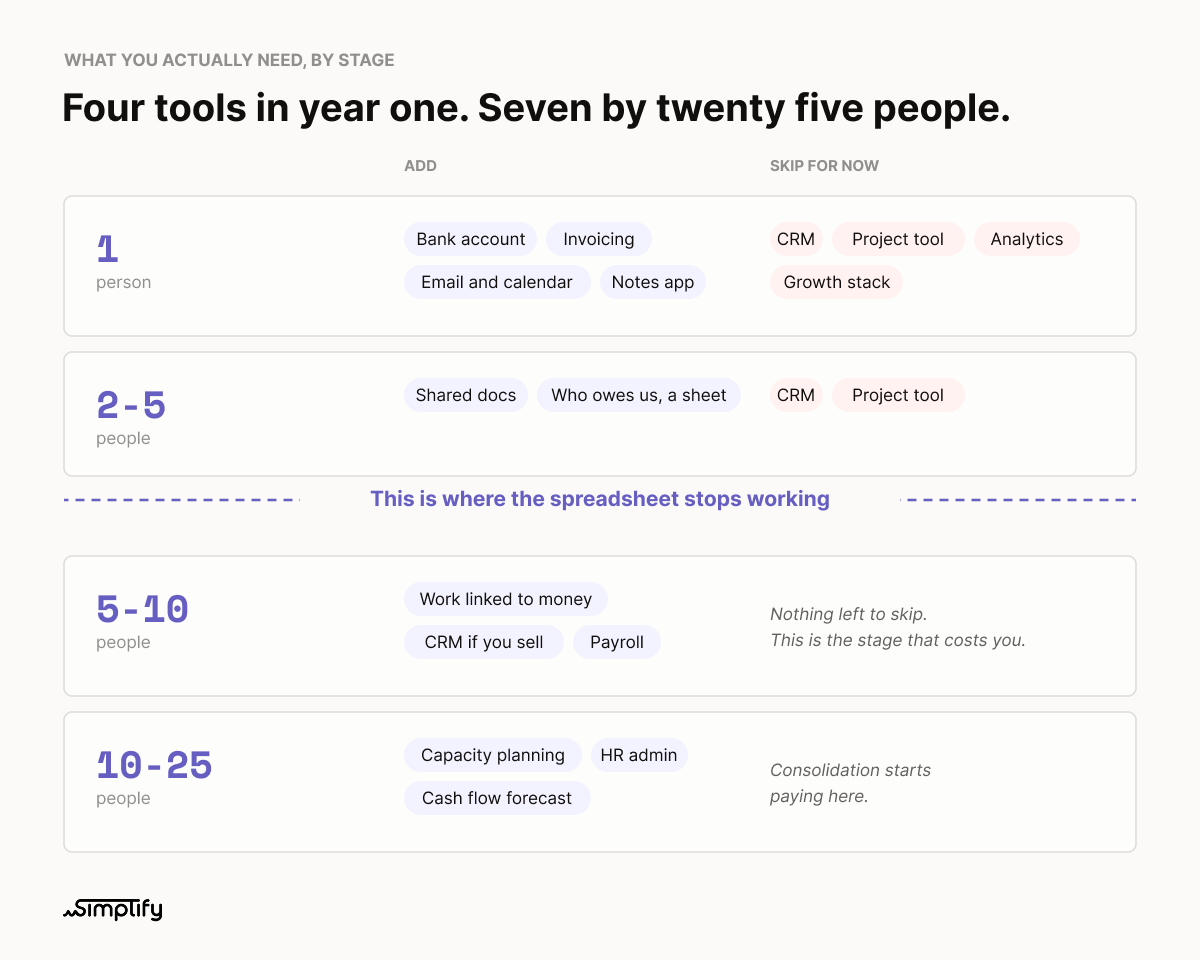
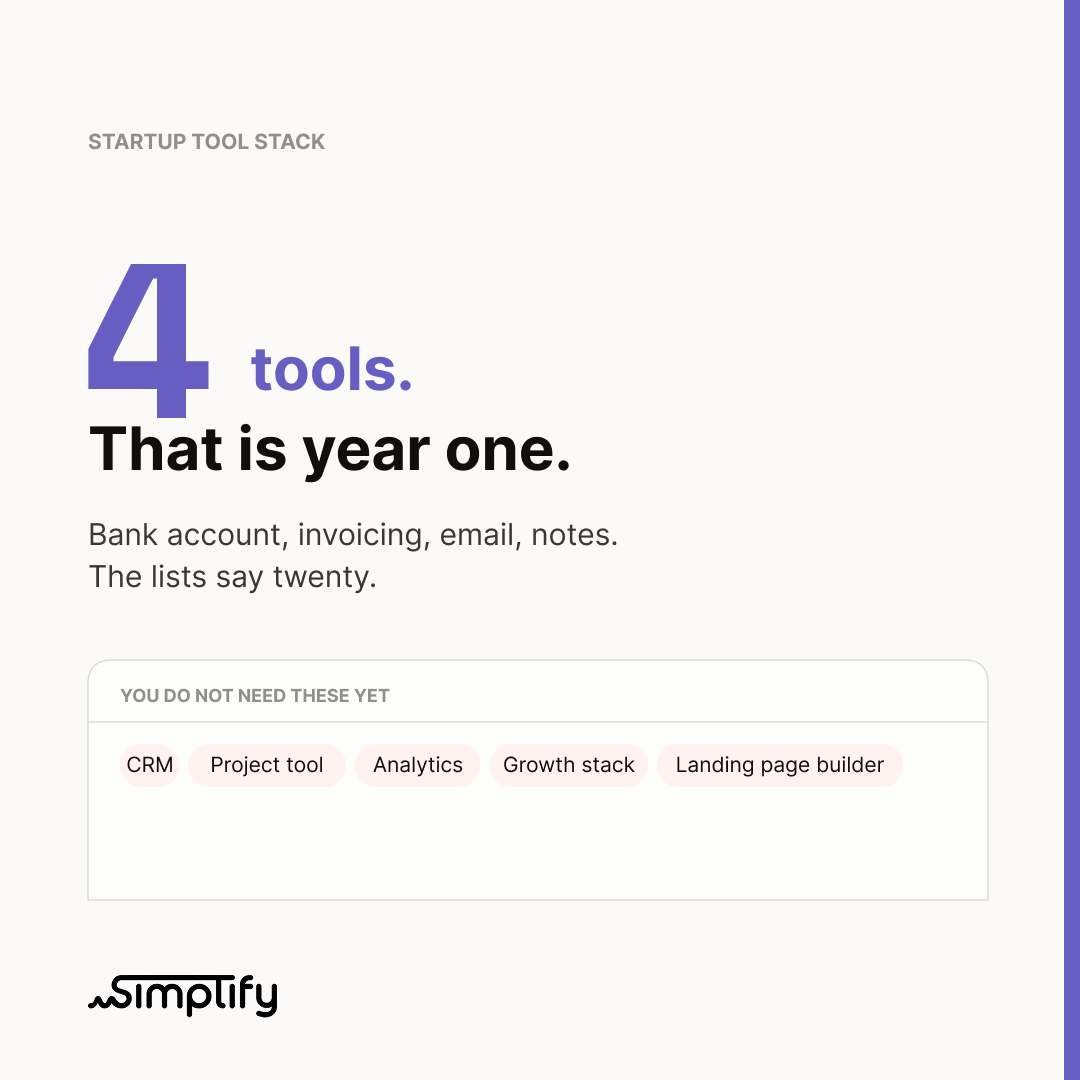
You need four things.
A business bank account. Separate from your personal one, from day one, for reasons your future accountant will explain at volume.
A way to send an invoice and get paid. Not accounting software. An invoice with your details on it and a way for someone to pay it.
Email and a calendar. You have these.
Somewhere to write things down. Any notes app. The one already on your phone is fine.
That is it. Three of those four are free or nearly free.
What you do not need at this stage, and this is the part the listicles will not tell you: a CRM, a project management tool, an analytics stack, a "growth stack," a design system, a Notion template someone sold you for forty euros, a landing page builder, or a scheduling tool. You have no customers. Every one of those is a tool for a problem you have not earned yet.
The most common early mistake is not picking the wrong tool. It is buying tools as a way of feeling like you are working.
Stage two: two to five people, money is arriving
Now add two things.
Shared files and documents. Google Workspace or Microsoft 365. Pick one, stop thinking about it.
A way to know who owes you money and when. This can be a spreadsheet. Honestly, at this size, it should be a spreadsheet.
Still not needed: a CRM. If you have fewer than about twenty open opportunities and one person is selling, a spreadsheet outperforms a CRM, because a CRM's value is coordination between people and you do not have people to coordinate.
Still not needed: a project management tool. Three people who sit near each other do not need software to know what everyone is doing. A shared list is faster.
The temptation at this stage is to set up the systems you will need later. Resist it. Every system has a maintenance cost, and at four people that cost is paid by the person who should be selling.
Stage three: five to ten people, and it breaks
This is the interesting stage, because something specific goes wrong and almost nobody sees it coming.
The spreadsheet stops working. Not because spreadsheets are bad. Because more than one person now needs to edit it, and the moment two people edit the same sheet, it stops being a source of truth and becomes a thing people argue about on Thursdays.
The same happens to the shared list, and to the folder structure, and to whatever informal system got you here.
What to add:
Something that connects the work to the money. This is the first genuinely hard purchase, and it is where the "does it need to know about money or who is doing the work" test starts earning its keep. At this size you have projects that make money and projects that quietly do not, and no way to tell which is which until you invoice.
A CRM, but only if you are actively selling. If your work comes from referrals and repeat clients, you still do not need one. If someone on your team spends real hours chasing new business, you do.
Payroll admin, whether that is a tool or an accountant, because now you have people and the rules are not optional.
Stage four: ten to twenty five people
Now the specific things.
Capacity planning, because "who is free next week" stops being answerable in your head.
HR admin, because holiday requests, contracts and reviews are now a real amount of work sitting on someone who was hired to do something else.
Cash flow forecasting, because at this size the question "how long does our money last" has a real answer that changes real decisions, and assembling it by hand takes an afternoon nobody has.
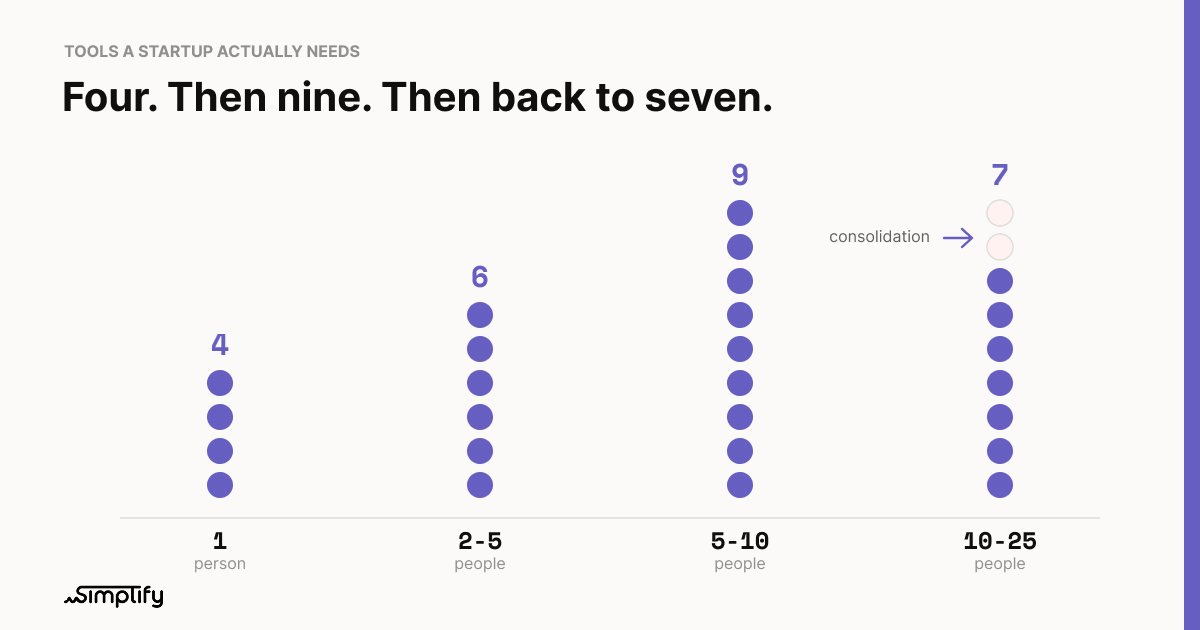
This is also where consolidation starts making sense, and not primarily because of the subscription cost. It is because by now you have six or seven tools, each holding one piece of the truth, and one person spending part of every week moving numbers between them. That person is the actual cost.
Free tiers that expire at exactly the wrong moment. Every free plan has a ceiling, and the ceiling is always hit during your busiest month. Then you are migrating under pressure, which is when people make bad decisions. Look at the paid price before you adopt the free one.
Per-seat pricing you stop noticing. Seats are bought for people who join. They are almost never cancelled for people who leave. That is the leak, and it grows quietly.
Tools bought for a problem you had once. Something went wrong, you bought software, the problem never recurred, the subscription did.
"We will grow into it." You will not. You will grow into a different problem and buy something else for that.
Anything with a setup cost longer than the problem it solves. If configuring it takes three days and it saves an hour a month, that is a four year payback and you will have churned by then.
The bit where we admit something
We sell an all-in-one platform. CRM, invoicing, cash flow, projects, hiring, payroll, in one place. You have probably worked out that the article above is describing the exact moment it becomes worth buying.
What we want to be clear about is the other direction. If you are one person, or three people, we are not the answer. Buying a connected system before you have anything to connect is the same mistake as buying a CRM with two customers. The value is in the connections, and connections need things on both ends.
If you are somewhere between five and ten people and you can feel the spreadsheet starting to go, that is when this conversation gets interesting. Before that, spend the money on something else.
We would also rather say this now than have you buy at the wrong stage, hate it, and tell people.
The honest summary
Most startups need four tools in year one. It climbs to about nine somewhere around ten people, which is the peak, and consolidation should bring it back to six or seven. The shape matters more than any single number: it goes up, and then it is supposed to come back down. Every list that says otherwise is being paid by the difference.
The signal to watch is not headcount. It is the first time two people need to edit the same thing and neither is sure which version is right. That is the moment your informal system stopped working, and everything you buy before then is decoration.